
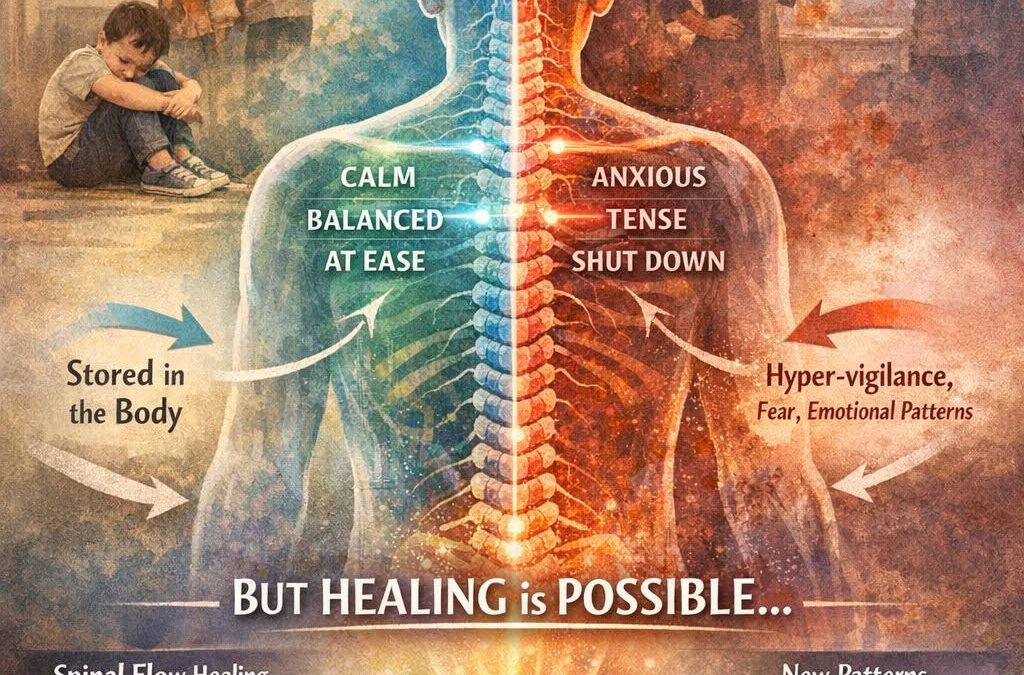
It’s not ‘What’s wrong with you?’ It’s ‘What happened to you?’
Modern neuroscience is revealing something profound: your adult body still carries the imprint of your childhood nervous system. Long after memories fade, the way your nervous system learned to respond to the world as a child continues to influence how you feel, react & regulate stress as an adult.
The nervous system develops rapidly in early life. During childhood, especially in the first few years, the brain & body are constantly scanning the environment for safety or danger. These signals shape the autonomic nervous system, which controls involuntary functions like heart rate, breathing, digestion & stress responses.
If a child grows up in a calm, predictable & supportive environment, their nervous system tends to learn balance. It becomes skilled at moving between states of alertness & rest. But when a child experiences chronic stress, neglect, fear or instability, the nervous system adapts for survival. It may become hyper-alert, shut down emotionally or stay stuck in stress mode.
This is not a failure, it is adaptation.
The body learns what it needs to do to survive its early environment. Those patterns can include being constantly on guard, dissociating, people-pleasing, or having difficulty relaxing. As adults, these responses often show up as anxiety, chronic tension, digestive issues, emotional numbness or difficulty regulating emotions even when life is no longer dangerous.
Importantly, these patterns are stored in the body, not just the mind. The nervous system remembers through muscle tension, breathing patterns, posture & hormonal responses. This is why logic alone cannot override stress reactions. The body reacts before conscious thought has time to intervene.
Researchers studying neuroplasticity have also found hopeful news. While early nervous system wiring is powerful, it is not permanent. The nervous system remains adaptable throughout life. With supportive experiences, therapy, mindful practices & safe relationships, the body can learn new patterns of regulation.
Practices such as slow breathing, somatic therapy, trauma-informed counselling, gentle movement & consistent emotional safety can help retrain the nervous system. Over time, the body learns that it no longer needs to stay in survival mode.
This research has reshaped how scientists & clinicians understand trauma, stress & healing. Rather than asking, ‘What’s wrong with you?’ the focus shifts to ‘What happened to you & how did your body adapt?’
Understanding that your nervous system carries your history can be deeply validating. It reframes symptoms not as weakness, but as intelligent responses learned early. Healing then becomes less about forcing change and more about teaching the body that safety is possible now.
Your adult nervous system is not broken.
It is experienced.
And with the right support, it can learn new ways to exist – calmer, safer & more at ease than before.
Source: National Institute of Mental Health (NIMH) – Stress & Brain Development